Recovery resistance,
dialed to the ounce.
Newhab is a lightweight wearable brace that adds gentle, precise resistance — from 0 to 5 lb — to therapy and recovery exercises. Turn a dial to the exact load a therapist prescribes, and it holds at any angle, so a healing arm or leg is never dropped and nothing snaps back.
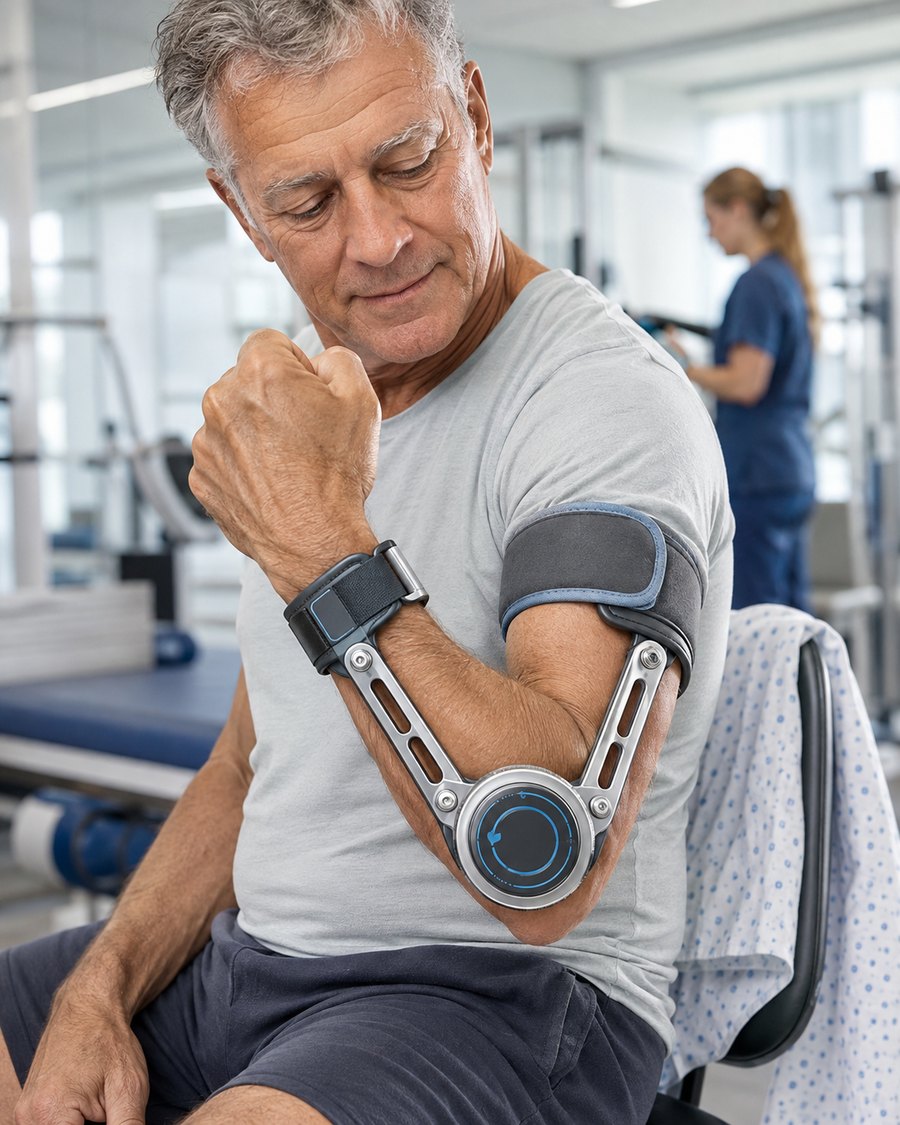
Gentle, exact, and it holds where you stop. Concept render.
This is not a brace that limits movement.
It is an exercise device that rebuilds muscle.
An ordinary rehabilitation brace restricts a joint to protect it. Newhab does the opposite: it lets the joint move through its range and works the muscle with adjustable tension instead of heavy weights. Lightweight, worn on the limb, and dialled to the exact load — so strength comes back, safely, without a dumbbell anywhere near a healing joint.

The Problem
Early rehab needs resistance measured in ounces — and safety above all.
In the first weeks after surgery, stroke, or injury, the right load can be under a pound. The tools therapists reach for weren't built for that: small weights can be dropped onto a healing joint, elastic bands pull back and can't hold a position, and neither lets you set — or record — an exact, repeatable number.
 Imprecise
Ounces matter, but tools guess
Bands and light weights can't be set to a specific sub-pound load, so the "dose" of exercise is approximate and hard to progress safely.
 Unsafe
A dropped weight sets recovery back
Free weights and stretched bands store energy. For a weak or painful limb, a slip or a snap-back can mean re-injury.
 Unmeasured
Progress that can't be tracked
Without a real number and a fixed hold, it's hard to document range, load, and improvement for the patient, the therapist, or the payer.
How It Works
Set the exact load. It holds where the patient stops.
The same core mechanism behind the invention — a friction brake, a one-way clutch, and a self-locking dial — is tuned here for the gentle, safety-critical world of early rehab.

Dial the prescribed load
A graduated dial sets gentle resistance across the 0–5 lb range in exact, repeatable numbers — a real dose a therapist can prescribe and progress.

Resist one way, ease the other
A one-way clutch can resist the working motion while leaving the return easy or free — supporting the limb through the range instead of fighting it both ways.

Holds anywhere — the safety piece
Because friction stores no energy and the dial is self-locking, the brace simply holds wherever the patient pauses. No drop, no recoil — the property that matters most for a fragile joint.
The Braces
Two wearable braces, for the joints rehab touches most.
For now, Newhab focuses on doing two things exceptionally well — a gentle, precise arm brace and leg brace. (Machines and higher loads are a separate effort.)

01Arm brace
Worn at the elbow (with wrist and shoulder variants planned) for post-op, stroke, and injury recovery of the upper limb — gentle graded resistance for flexion and extension.

02Leg brace
Worn at the knee (with ankle and hip variants planned) for gait, strength, and range-of-motion recovery in the lower limb — the same dial-set, hold-anywhere control.

03Graded dial & readout
A clear graduated dial sets the exact sub-pound load; a readout (and, later, a companion app) helps document range, load, and progress over a course of therapy.

04Comfort & fit
A soft sleeve and adjustable straps keep the compact mechanism secure and comfortable for home programs between clinic visits.
Concept renders. Newhab is in development and not yet available for sale.
Who It's For
Built for the people and places recovery happens.
Precise, safe, low-load resistance that works in the clinic and at home.

 Post-surgical rehabGentle graded loading in the early weeks
 Stroke recoverySupported, repeatable upper- and lower-limb work
 Sports & injury rehabPrecise progression back to strength
 Older adultsSafe strength and fall-prevention work
 PT & OT clinicsA measurable, documentable exercise dose
 Home programsClinic-grade control between visits
 Veterans & VA careRecovery and reconditioning support
 Pediatric & neuro rehabVery light, carefully controlled loads
Benny Labs
A nonprofit effort to put precise, safe rehab within everyone's reach.
Newhab is co-developed with the Benny Labs Foundation, an approved 501(c)(3) not-for-profit dedicated to affordable rehabilitation technology. Our aim is to fund development and keep the device accessible through government and foundation grants, research partnerships, and collaborations with clinics — so cost is never the reason someone recovers less than they could.
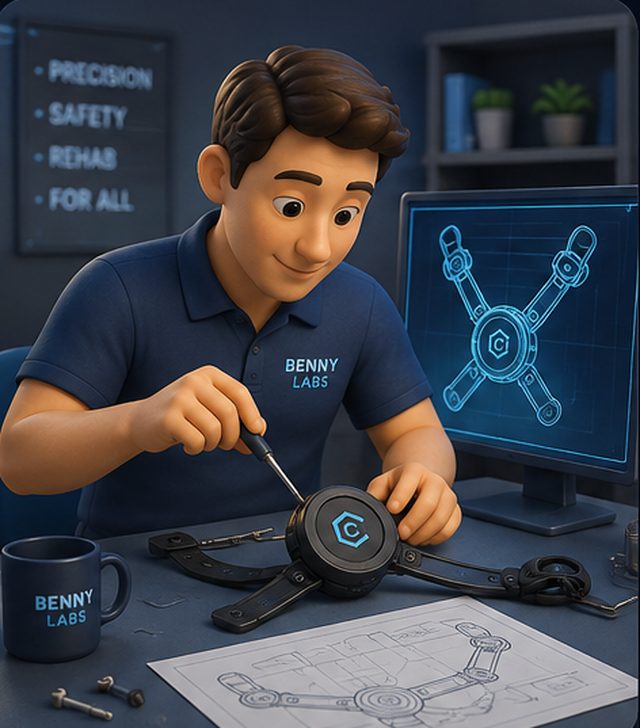
Grant-funded development
We are pursuing government and nonprofit grants to fund prototyping, testing, and clinical evaluation — keeping the technology mission-first.
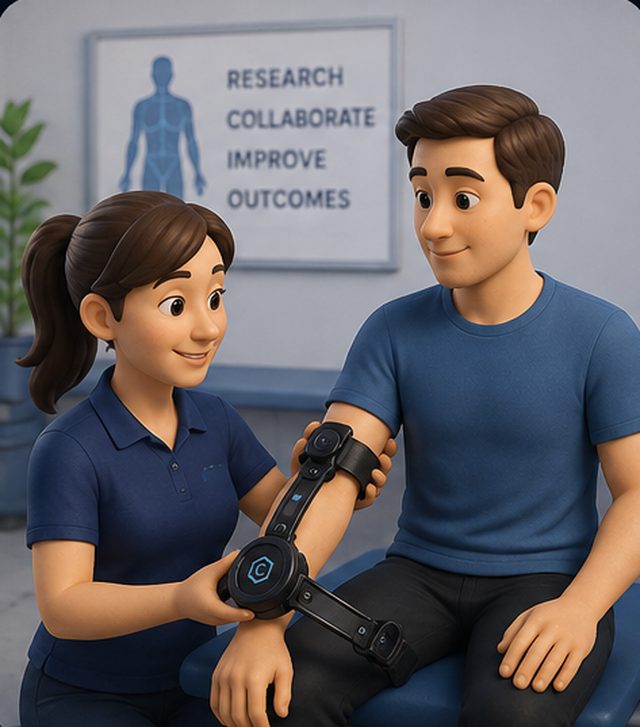
Clinical & research partners
We're seeking therapists, clinics, and researchers to co-design and pilot the braces with real patients and real outcomes.
Access-first
The goal is a device clinics and patients can actually afford — distributed through partners, grants, and programs rather than priced out of reach.

The Founder
Benny Goldstein
Founder & Inventor, Benny Labs
Benny invented the direction-dependent resistance mechanism behind Newhab and founded Benny Labs to get it into the hands of the people who need it most.
A lawyer by training — LLB and LLM, specialising in patent and contract law — he drafts and files his own patent applications, including the one protecting this device.
The Benny Labs Foundation is an approved 501(c)(3) not-for-profit, and that is deliberate. The earliest weeks of recovery are where precise, safe loading matters most, and they are also where the available tools are weakest. Building this as a mission rather than a margin is what keeps it reachable for the clinics and patients who stand to gain the most from it.
The Invention
Protected by a filed U.S. patent application.
Direction-Dependent Resistance Mechanism for Exercise and Rehabilitation — U.S. Application Patent Pending.
 Sets and holds the load
A self-locking, non-backdrivable dial sets the brake load and holds it under any force — the property that keeps a fragile limb safe.
 Direction-dependent by design
A one-way clutch can resist the working motion while easing the return, supporting the limb through its range.
 Compact & wearable
The mechanism is small enough to sit comfortably in a joint brace with a graduated, therapist-set dial.
Patent pending. Newhab is an investigational rehabilitation device in development; it is not FDA-cleared and no medical claims of treatment efficacy are made. Nothing here is a guarantee of grant, scope, or performance.
Get In Touch
Clinics, researchers & grant partners.
If you'd like to pilot Newhab, collaborate on research, or explore grant and nonprofit funding with the Benny Labs Foundation, we'd love to hear from you.
Follow the work — or partner with us.
Newhab is patent pending and in active development, co-developed with the Benny Labs Foundation. Whether you're a therapist, a clinic, a caregiver, a researcher, or a potential grant or nonprofit partner, leave your details and we'll keep you posted — and reach out about pilots and collaborations.
Thank you — you're on the list.
We've got your details and we'll be in touch as Newhab moves forward.
Questions in the meantime: hello@newhab.life
The Business Plan
A home rehabilitation device, and what it takes to build it.
Newhab is designed to leave the clinic. A therapist sets the prescription; the patient takes the brace home, dials the load themselves, and works the joint between visits — with a device that cannot drop and cannot snap back. Below is what exists today, what it costs to finish, and what we are honest about not yet knowing.

What we are raising, and what it buys
Three tranches, each tied to a specific deliverable. We are pursuing a blend of non-dilutive grant funding and private investment.
Final working prototype
- Bench rig and torque-versus-angle characterisation across the full 0–5 lb range
- Three design iterations of the clutch and brake assembly
- CAD, design-for-manufacture and materials selection
- A small batch of functional units for usability testing
First production run
- Injection-mould tooling and first-article inspection
- A first run of a few thousand units
- Assembly, quality control and packaging
- Fulfilment setup and initial inventory
International patent filings
- PCT international application
- National-phase entry in priority markets
- Translations and national filing fees
- Design-patent protection on the housing

The market
Every figure below is sourced and dated. Where published estimates disagree, we say so and use the smaller one.
That is net revenue per patient visit at the largest US outpatient physical therapy operator — 6.15 million visits across 780 clinics (FY2025). A clinic netting roughly a hundred dollars a visit cannot absorb a device out of visit margin, and cannot supervise the patient on the days they are not in the building. That gap — between visits, unsupervised, at loads a therapist would actually prescribe — is the entire product thesis.
Competitive landscape
There is no shortage of joint bracing. What is absent is a passive device that resists motion in one direction, leaves the return free, and holds position anywhere — at a price a patient can take home. These are the products a reviewer would reasonably name as competition.
| Product | What it does | Typical price | Where Newhab differs |
|---|---|---|---|
| Spring Loaded Technology |
Spring-loaded knee bracing that stores and returns energy | ~$2,000+ | Springs assist the wearer. Newhab resists and holds — friction stores no energy to give back. |
| JAS · Ultraflex DynaSplint |
Static-progressive and dynamic splints for contracture and stiffness | $1,000–5,000 often reimbursed |
Built to stretch a stiff joint, clinic-prescribed and costly. Newhab loads the muscle for strength, at a take-home price. |
| THERABAND elastic bands |
Colour-coded elastic resistance — what the therapist actually sends home today | A few dollars | The real incumbent. Eight colours span 2.4–14.2 lb, so the entire 0–5 lb clinical range is four discrete jumps — and nothing at all exists below 2.4 lb. Elastic also stores energy and recoils, climbs as you stretch it, and pulls both ways. |
| Biodex System 4 |
Isokinetic dynamometer — clinic-grade resisted muscle testing and training, with direction- and speed-dependent loading | $10,000–50,000+ | The clinic-grade benchmark, and proof that resisted, direction-dependent loading is established practice rather than a novel claim. It is a 900 lb machine bolted to a floor. Newhab does one narrow slice of that job as a passive wearable the patient takes home. |
| AGOGIE · Physiclo Tau Orthopedics |
Compression apparel with sewn-in elastic resistance | $49–129 | Elastic resists both directions, cannot be set to a number, and snaps back. No hold. |
| Newhab | Passive direction-dependent friction brake with a graduated 0–5 lb dial | Target: home price point | — |
SWOT
Written to be useful rather than flattering. The weaknesses and threats are the real ones, and they are the reason for the raise.
Strengths
- Direction-dependent by design. Resists the working motion while leaving the return free — passively, with no motors or electronics.
- Holds anywhere. Friction stores no energy, so the brace cannot drop like a weight or recoil like a band. This is the safety property that matters for a fragile joint.
- Continuous sub-pound adjustment where the incumbent — elastic bands — offers just four discrete steps across the entire 0–5 lb clinical range.
- Entirely passive — nothing to charge, no battery, no electronics to certify or fail.
- Patent pending, with a US application on file since June 2026.
- Likely Class I, 510(k)-exempt pathway under 21 CFR 890.3475 (limb orthosis).
- Nonprofit status is a real advantage for a specific funding tier — FuzeHub and the Neilsen Foundation are closed to for-profits entirely.
Weaknesses
- No clinical data of any kind. Nothing has been tested on a patient. Every performance statement is currently a design intent.
- No production-representative prototype yet, and no bench torque data collected.
- Single inventor. No engineering, regulatory, quality or commercial team in place.
- No reimbursement pathway — there is no HCPCS code for this device, so it would launch cash-pay.
- No manufacturing partner, tooling or supply chain established.
- A 501(c)(3) can neither hold an SBIR award nor issue equity. Both halves of a conventional funding plan are therefore unavailable to Benny Labs as constituted — see the note below.
Opportunities
- Care is moving out of the clinic and into the home, and payers are pushing it there.
- An ageing population and rising joint-replacement volumes expand the rehabilitation population every year.
- A genuine price gap: reimbursed static-progressive splints run into the thousands; nothing serves this function at a consumer price.
- Graded, direction-dependent resistance is unoccupied territory in take-home devices.
- A deep grant landscape exists specifically for rehabilitation engineering.
- The same mechanism scales to other joints and to gym equipment — a second market from one invention.
Threats
- Incumbent distribution. Össur, Breg and DonJoy own the clinical channel and could build a mechanical equivalent if the category proves out.
- Hardware startups fail on manufacturing, not ideas. The closest comparable — Spring Loaded, also a passive mechanical knee brace — consumed several million dollars of venture, government and crowdfunding capital to reach market, roughly an order of magnitude beyond this raise.
- The largest commercial payer has already ruled against this device class. UnitedHealthcare policy 2026T0481BB, effective 1 January 2026, deems patient-controlled mechanical stretching devices “unproven and not medically necessary… due to insufficient evidence of efficacy.” Patient-adjusted-at-home is our core positioning and it sits inside that category. Policy
- The 510(k) exemption is conditional. 21 CFR 890.9 withdraws it where a device uses a different fundamental technology than the predicate. The listed predicates are a knee cage, an elastic stocking and a corrective shoe — all passive supports with no mechanism. A clutch-and-brake assembly invites the argument.
- Patent scope may end up narrower than hoped; adjacent granted claims exist in elbow bracing.
- Regulatory and advertising exposure if marketing outruns the evidence.
- Product liability — a device that loads a healing joint carries real risk that must be designed and labelled for.
- Without reimbursement, the addressable market is limited to what patients will pay directly.
Milestones
Each phase is gated on the one before it. Durations are planning estimates.
PHASE 01
Characterise and finalise
~6 months · $50k
Bench rig, torque-versus-angle data at every dial setting, three iterations to a design freeze, and a small batch of functional units.
PHASE 02
Usability and design lock
~4 months
Therapists and patients set prescribed loads unsupervised. Fit, comfort and all-day wear. Labelling and instructions for use drafted.
PHASE 03
Tooling and first run
~6 months · $250k
Injection-mould tooling, first-article inspection, quality system, and a first production run of a few thousand units.
PHASE 04
Clinical pilot and launch
~8 months
A controlled pilot with a partner clinic, published results, and first distribution through clinics and grant-funded programmes.
Planned research programme
None of the following has been conducted yetThese are the studies the raise pays for, in the order they must happen. We are stating them here so that partners and reviewers can hold us to the design rather than to a claim.
Stage 1 · Bench
Torque–angle characterisation
- Design
- Instrumented hinge rig, load cell and goniometer, 0–150° sweep at every dial setting
- Sample
- Mechanical — 10 units, 5 runs each
- Primary outcome
- Resisting torque as a function of joint angle, and repeatability between units
- Purpose
- Turns the dial markings into a defensible specification instead of a claim
Stage 2 · Bench
Durability and setting drift
- Design
- Accelerated cycling to 100,000 flexion–extension cycles, with periodic re-measurement
- Sample
- 6 units
- Primary outcome
- Change in delivered torque at a fixed dial setting over life
- Purpose
- A dial that drifts is a dial that lies. This establishes service life.
Stage 3 · Human factors
Usability and safe self-adjustment
- Design
- Task-based usability study; participants set a prescribed load unsupervised at home
- Sample
- ~20 patients and ~10 therapists
- Primary outcome
- Accuracy of the set load against prescription, and use errors observed
- Purpose
- The whole product rests on a patient adjusting it correctly without a clinician present
Stage 4 · Clinical
Controlled pilot
- Design
- Randomised pilot against a standard home exercise programme, partner clinic
- Sample
- ~40 participants in post-operative elbow or knee rehabilitation
- Primary outcome
- Change in range of motion and strength at 8 weeks
- Secondary
- Adherence to the prescribed programme, and adverse events
Funding strategy
Newhab runs on a two-entity structure that already exists. Benny Labs Foundation holds the research and access mission and applies for charitable and foundation funding. Mathknight LLC, the founder's for-profit vehicle, holds the commercial track, can take equity investment, and is eligible for SBIR and STTR. The two draw from different pools and do not compete for the same dollar.
That matters because of what sits behind the for-profit door: a single SBIR Phase I ($323,090 statutory guideline, or up to $305,000 at NSF) would fund this entire raise outright.
| Programme | Ceiling | Fit — and the catch |
|---|---|---|
| NIH Parent R21 PA-25-306 | $275,000 over 2 years |
501(c)(3) organisations are explicitly eligible — the largest grant Benny Labs could hold in its own name. Catch: R21 is a research mechanism. Reviewers want a hypothesis and a study, not a prototype build. |
| FuzeHub Manufacturing Grants (NY) | $65,000 | The best structural fit found. The lead applicant must be a New York not-for-profit partnered with a NY manufacturer under 500 employees — precisely our shape, and it covers most of the prototype tranche. The 2026 round has closed; target spring 2027. |
| Craig H. Neilsen Foundation | Programme-dependent | Grants go only to nonprofits, so our status is an advantage. Catch: strictly spinal-cord-injury scoped and reviewed by SCI clinicians — it needs a genuine SCI application, not a relabel. |
| NIH SBIR via NICHD/NCMRR | $323,090 Phase I $2.15M Phase II |
Strongest topical fit — NCMRR's remit expressly covers orthotics and assistive devices. Requires the for-profit entity. Receipt dates 5 Sep, 5 Jan, 5 Apr. |
| NSF SBIR Phase I | up to $305,000 | Requires an invited Project Pitch before a full proposal — a gating step first-timers miss. Also requires the for-profit entity. |